

August 11, 2026
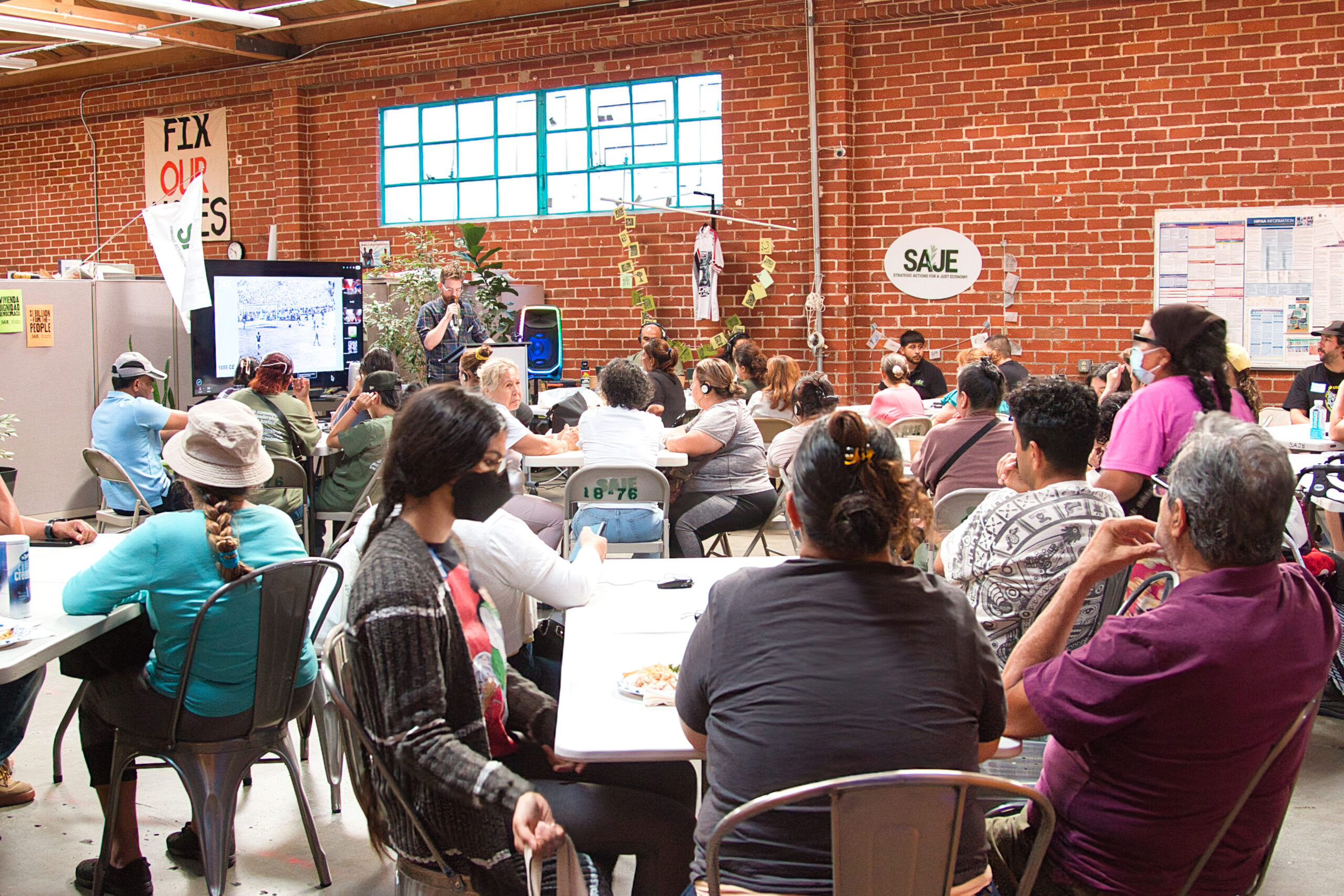
On Thursday evening, August 6, SAJE hosted “Profiting Off the People’s Game: A Community Discussion,” as part of our ongoing Escuelita series. Escuelitas are a space for the public to gather and learn more about the issues impacting their neighborhoods and communities as well as how to have a voice in civic processes. Past topics have included the city’s budgeting and charter reform processes, while Thursday’s session focused on the impacts of the FIFA World Cup on L.A.
“Profiting Off the People’s Game” began with a SAJE presentation on the history of soccer, the founding of FIFA, and the evolution of the World Cup into a billion dollar enterprise. Nico Aviña, who co-runs the arts space Espacio 1839 in Boyle Heights, spoke about soccer as an important cultural tradition in L.A.’s immigrant communities. There are an estimated 265 million soccer players worldwide, and cultures across the globe have been playing variations of the game for thousands of years—long before the Fédération Internationale de Football Association (FIFA) was founded in Paris in 1904.
Escuelita participants also learned about the economics of the FIFA World Cup. The 2026 games generated approximately $15 billion in revenue from ticket sales, sponsorships, broadcasting rights, and other profit-making arrangements. FIFA does not share these revenues with host cities; at the same time, cities typically spend hundreds of millions of taxpayer dollars on security, transportation, stadium upgrades, and other services for the privilege of hosting. Which raises the question, “What did Angelenos get out of all of this?”
Escuelita was the place to answer that question. During our community discussion, most participants reported that while they watched the games on television and enjoyed the feeling of team spirit, the cost of tickets made it prohibitively expensive to attend. Some said they appreciated the upgrades to LA Metro, and wished the system could run that smoothly all the time, not just during the World Cup. A street vendor commented that it was harder to make sales because of vending restrictions around SoFi Stadium, while no one reported reaping benefits from the economic activity the World Cup is alleged to have stimulated.
SAJE plans to compile what we learned during Escuelita into a “report card” we hope will inform city preparations for the 2028 Summer Olympic Games. Our Escuelitas are open to the public, and Spanish and English translation is provided. Our next Escuelita is Thursday, October 1. You can follow our Instagram page for updates and registration information.