

By Iris Craige, Assistant Director of Policy and Advocacy
May 7, 2026
In the days immediately following the Eaton Fire, while Altadena residents were still navigating the devastation of the disaster, many began receiving calls and text messages from corporate investors asking if they were willing to sell their homes. These calls were sometimes framed as offers of help, like “remediation services” or “insurance assistance,” but then callers would quickly shift into attempts to purchase fire victims’ property. For many residents, the experience was confusing, persistent, and distressing. In some instances, potential buyers even reached out to the family members of fire victims.
The experiences of Altadena residents who lost their homes point to a broader reality: disaster recovery is an opportunity for exploitation. Homeowners navigating displacement, grief, financial uncertainty, and the trauma of loss are often being approached by actors seeking to acquire property precisely because they are in crisis. A resident I spoke with shared that after losing her home, she began receiving unsolicited calls, texts, and emails from potential buyers. These calls became persistent and harassing and have continued more than a year after the fire. In one case, a real estate developer claimed to represent a “family looking to build their dream home.” She described this as deeply distressing, as her own home had just burned to the ground.
Unfortunately, the data show how widespread the pressure to sell to corporate investors has become. In the year before the Eaton Fire, about 8% of home purchases in Altadena were made by corporate entities. Within a year after the fire, that figure rose to around 60%, reflecting a more than sevenfold increase. These patterns indicate a housing market shaped by displacement, uncertainty, and unequal bargaining power.
At first glance, these purchases may appear small in scale. Most buyers acquired just a single property in Altadena, with an average of 1.3 properties per buyer. But when we link these transactions to broader ownership data, a different picture emerges. For example, the largest purchaser in Altadena acquired 22 properties following the fire and is associated with more than 50 properties across Los Angeles County, held across multiple LLCs. Similarly, a buyer who acquired six properties in Altadena is connected to more than 60 properties countywide, spread across dozens of ownership names.
These patterns highlight how investor activity can be obscured through fragmented ownership structures, making it difficult to identify the scale of corporate ownership. Homeowners who have tried to report unsolicited offers to the authorities often lack sufficient identifying information—but obtaining it would require them to further engage with the very people pressuring them to sell. This dynamic places an unreasonable burden on disaster survivors to regulate these unsolicited offers, which is why putting protections in place before crises happen is critical.
Following the Eaton and Palisades Fires, in response to widespread reports of unsolicited and predatory purchase offers, California Governor Gavin Newsom issued an executive order temporarily prohibiting specific below-market offers in designated wildfire-affected areas. AB 851 (McKinnor) built on those emergency protections by establishing restrictions on unsolicited purchase offers for up to one year following a disaster. Now, a new bill, SB 1090 (Perez) has been introduced to expand those protections by extending the timeline to five years and broadening restrictions on unsolicited purchase offers from large corporate property owners.
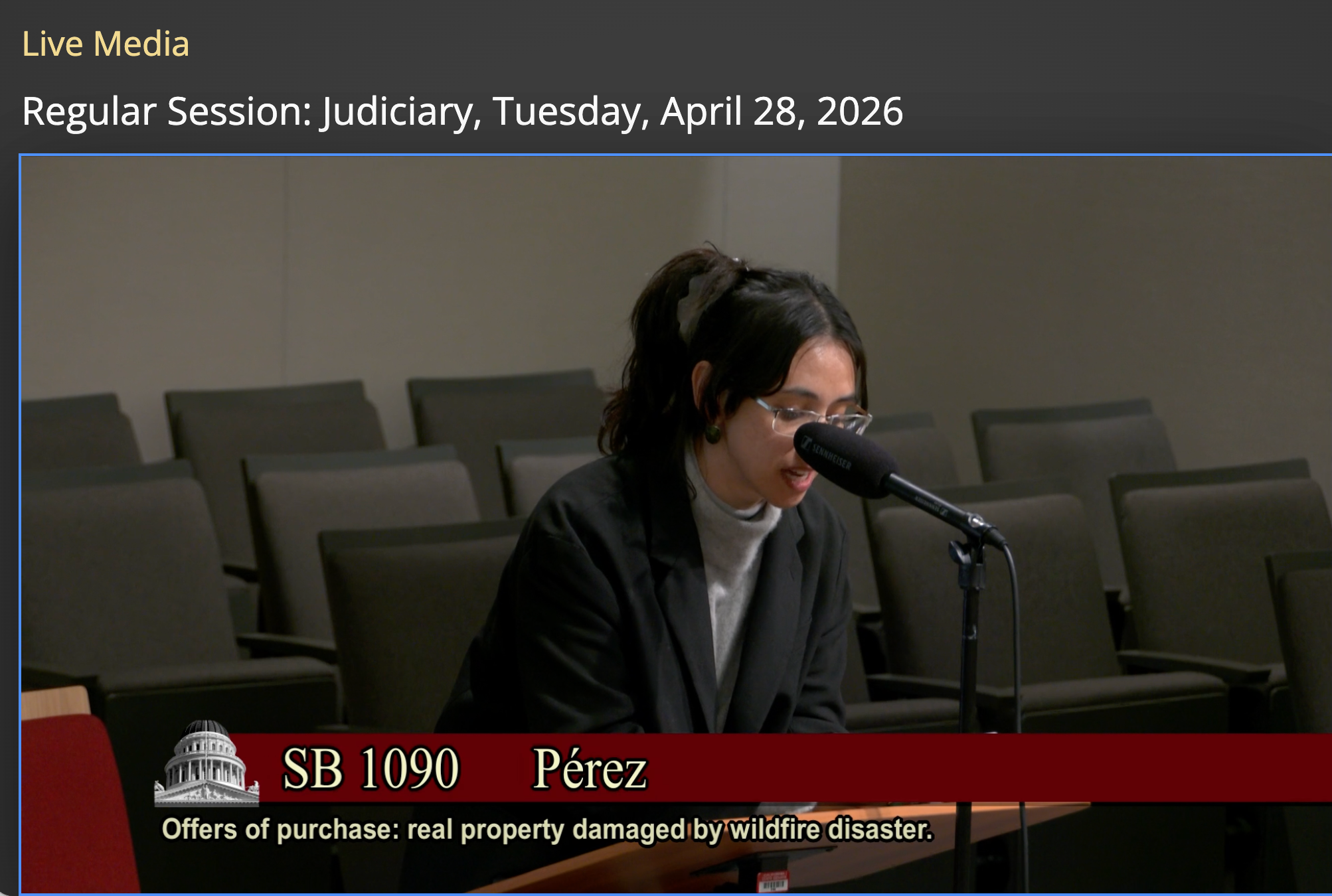
Last week, I traveled to Sacramento to testify in front of the Senate Judiciary Committee in support of SB 1090, sharing SAJE’s analysis of post-fire investments and what we’ve heard from Altadena residents. SB 1090 would directly address our concerns about predatory corporate buyers by prohibiting unsolicited offers in wildfire-affected areas from individuals or entities that own, directly or indirectly, 75 or more single-family properties. The bill would apply these protections for five years following a declared disaster, but would not prevent homeowners from selling their property. Instead, it would ensure households are able to make their decisions freely, without harassment or pressure during a moment of crisis.
SB 1090 will create meaningful protections in response to the predatory real estate practices that emerge in the aftermath of disaster. But ensuring those protections are effective will require enforcement mechanisms that do not place the burden on disaster survivors to investigate the individuals soliciting them as well as continued scrutiny of how investor activity is structured across multiple entities in practice.
Households recovering from wildfires need time to recover, regroup, and make informed decisions about the future, free from pressure and harassment. Residents should have the space to decide if and when to sell on their own terms, not under duress, and certainly not in the immediate aftermath of a crisis.