

By SAJE Staff
May 6, 2026
Last year, California spent nearly $1.5 billion to combat homelessness, funding rental assistance programs, interim housing, and housing vouchers, among other programs. But state policymakers responsible for lowering rates of homelessness are too often working in the dark because they lack critical information about the hundreds of thousands of evictions filed each year across the state.
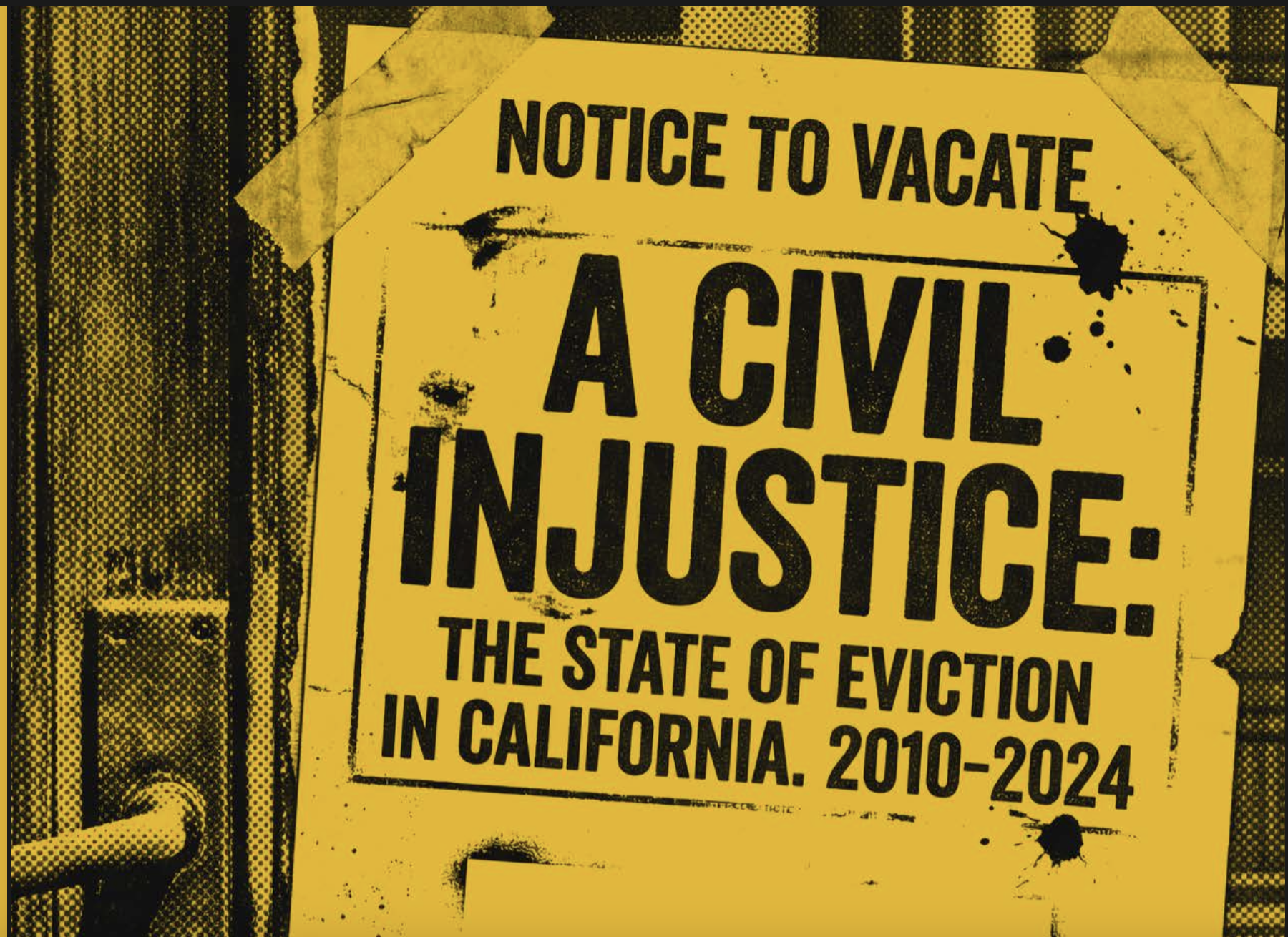
According to “A Civil Injustice: The State of Eviction in California, 2010–2024,” a new report published by Strategic Actions for a Just Economy (SAJE) and Housing Now!, evictions are a leading driver of homelessness in California, but the state is doing a poor job of tracking and understanding them. The report found that while California counties uniformly report on eviction filings, just 86% report on legal outcomes in eviction court.
Eviction court outcomes are different, and in many ways more important, than filings. Filings represent the number of evictions initiated, while outcomes are what actually happened during the legal process—whether the tenant lost their home, settled with their landlord, or had their case dismissed, for example.
What’s worse: The eight California counties that don’t report on eviction outcomes include Los Angeles, San Diego, Sacramento, and Riverside Counties, where more than 57% of the state’s evictions are filed.
The report also examines eviction outcomes data from 2010 and 2024 to glean partial insight into how evictions are playing out across California. Among the findings:
- The most frequent eviction outcomes were defaults (a period average of 46.02%) and dismissals (a period average of 33.44%), comprising a period average of nearly 80% of total outcomes
- Nearly all defaults (96.49%) were a result of tenants not responding to landlords’ eviction lawsuits within the mandated five-day period
- Trial outcomes (a period average of 10.76%) and negotiated outcomes (a period average of 7.86%) were rare
In February, California State Senator Maria Elana Durazo introduced SB 1160, which would require all 58 of the state’s County Superior Court systems to report information regarding unlawful detainer cases, aggregated by ZIP Code, once per quarter. This would help California embrace a truly data-driven homelessness prevention policy.