


Please Note: We updated our position on Measure A to a NO endorsement on October 9.
Our positions on these state, county, and city measures are offered in the spirit of advancing a more just economy for all. Note that because of our 501(c)(3) status, we are unable to endorse political candidates. Paid for by SAJE.
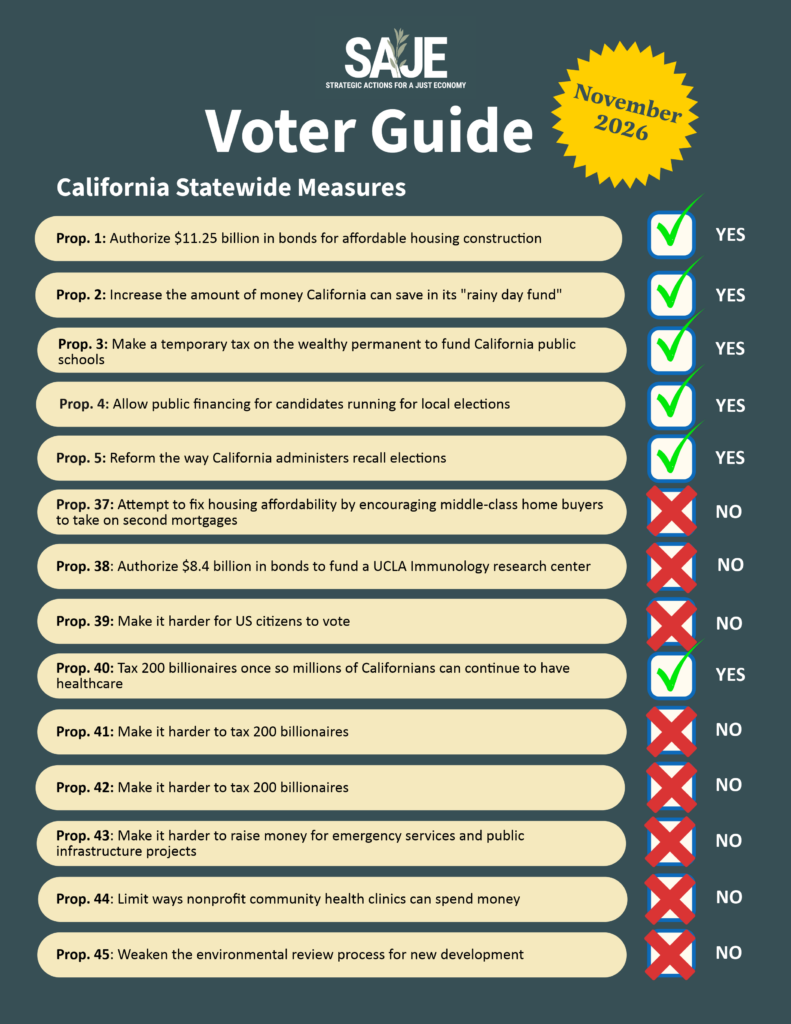
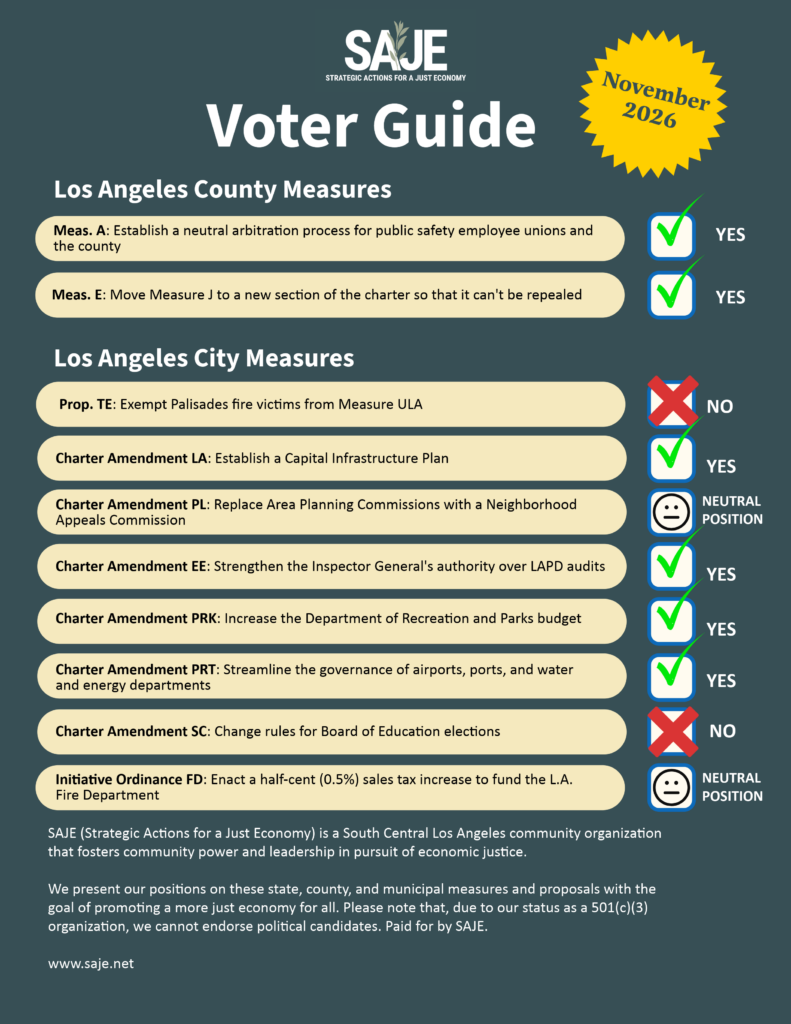
You can download a PDF of our voter guide here.
CALIFORNIA STATEWIDE MEASURES
YES on Prop. 1: Veterans and Housing Assistance Programs Bond
California urgently needs more affordable housing, but developing and rehabilitating it is expensive and difficult to finance. To address this problem, the state legislature passed the Veterans and Affordable Housing Bond Act of 2026 (SB 417), unlocking a way for the state to raise money for affordable housing by issuing bonds. Prop. 1 would give California the ability to issue $11.25 billion in bonds to fund affordable housing construction and rehabilitation, including $5.1 billion for the CA Multifamily Housing Program, $1.25 billion for housing for military veterans and their families, and $1.15 billion for supportive housing, among other initiatives.
Bond measures are an imperfect vessel for financing affordable housing construction; when interest rates are high, cities (and taxpayers) can be on the hook for higher-than-anticipated repayment costs. But California needs affordable housing, and Prop. 1 offers a tangible pathway towards progress. Cities could also explore more efficient ways of financing affordable housing development through other mechanisms, like creating a public bank or by building public housing directly. VOTE YES.
YES on Prop. 2: Budget Stabilization Account Cap Increase and Gann Limit Changes
California maintains a Budget Stabilization Account (BSA), a “rainy day fund” that can be used for essential services and to pay down debt during budgetary emergencies. Currently, the state can authorize contributing up to 10% of its General Fund tax revenue to the BSA each year. But that doesn’t necessarily mean California gets to make the maximum contribution, even if it wants to. Contributions are constrained by “the Gann Limit,” a constitutional amendment enacted by 1970s antitax reactionaries that caps the share of tax revenue state legislators are allowed to spend in a given year, based on inflation and population growth. Prop. 2 would amend the state constitution to both increase the percentage of General Fund tax revenue that California can contribute to its BSA from 10% to 20% and exempt these contributions from the Gann Limit. This would allow the state to build a rainy day fund capable of safeguarding public services in an increasingly volatile national economy. VOTE YES.
YES on Prop. 3: Renew State Income Tax Increase for Education Funding
In 2012, California voters agreed to raise income taxes on individuals making a minimum of $360,000 per year and on couples making a minimum of $721,000 per year. The tax rate is proportional to income, so a person making $1 billion annually is taxed at a higher rate than someone making $360,000 annually. Most revenue is used to fund public K-12 schools and community colleges, and the rest funds public healthcare. This tax will expire in 2031, and Prop. 3 would make it permanent, with no change in the status quo—California’s high-income earners will continue to be taxed at the same rate they’ve been paying for the past 15 years. SAJE believes progressive taxes—taxes that require high earners to contribute proportionally more of their resources than lower earners—are the best way to fund schools, healthcare, housing, and other public goods and services. VOTE YES.
YES on Prop. 4: Allow Public Financing of Election Campaigns
Prop. 4 would allow California state and local governments to create public campaign-financing programs for candidates. Spending limits and eligibility rules would apply, but these programs would provide public funds to eligible candidates who demonstrate sufficient broad-based support, such as through small-dollar contributions or voter vouchers. The measure would prohibit public funds from being used for legal defense fees, fines, or repaying personal campaign loans. It would also prevent eligibility rules from discriminating based on party affiliation or whether a candidate is an incumbent or challenger.
Expanding access to financing opportunities for political candidates would even the playing field by making it possible for leaders from different socioeconomic backgrounds to run. Public financing also would make it easier for grassroots candidates without wealthy personal networks or major donors to compete for office. And reducing reliance on large private contributions could curtail the growing influence of billionaires, wealthy donors, and special interest groups in election results. VOTE YES.
YES on Prop. 5: Eliminate State Officer Recall Successor Elections
Prop. 5 would change California’s process for replacing elected state officers—e.g., the governor or the secretary of state—when they are recalled from office. Under current recall rules, voters are tasked with two separate questions on the same ballot: whether to remove the person from office, and who should replace them. Prop. 5 would amend this process so the recall election comes first, followed by a separate special election for that office if the recall is successful. (An interim official would hold responsibilities until the special election can take place.) Prop. 5 also would remove a ban on recalled elected officials re-running for the same position. By untangling the recall vote from the vote for a successor, Prop. 5 would make it harder for special interests to use recall elections to win control of an office without having to go through standard election processes. VOTE YES.
NO on Prop. 37: Second Mortgage Homebuyer Program and Revenue Bond
Prop. 37 would create a home loan program backed by $25 million in bonds to help middle-income California residents buy qualifying new homes. These loans would essentially function as fixed-rate second mortgages—they would cover 17% of a 20% payment on homes priced under $1.5 million, but not the entire cost of the home, and they would need to be paid back with interest. But the interest rate and loan terms are not written into the measure, so who knows whether the program will give homebuyers a better deal than what banks are already offering. And if borrowers default on their loans, there may not be enough money to repay the bonds, in which case the state will be stuck with the bill. Prop. 37 does not meaningfully address California’s housing affordability crisis, it just makes it easier for some Californians to purchase homes they otherwise wouldn’t be able to afford by taking on more debt. VOTE NO.
NO on Prop. 38: Immunology and Immunotherapy Research Funding
Prop. 38 would authorize California to issue $8.4 billion in general obligation bonds to fund immunology and immunotherapy research. Though not specifically named, UCLA’s California Institute of Immunology and Immunotherapy (CIII) would get half the money because, the way the legislation is written, they are the only institute that qualifies for it. The other half would go to nonprofit research centers in California, but the CIII would have a say in which ones. UCLA previously received $500 million from the State of California to establish and fund the immunology institute, and private donors from the worlds of tech, biotech, and real estate have also pledged support; UCLA describes the venture as a “public-private partnership.” At SAJE, we don’t like legislation that targets or benefits one organization (see the AIDS Healthcare Foundation and Prop. 34 in 2024). We also think it’s both unfair and unwise to allocate so much public funding to just one place, especially one beholden to private interests. VOTE NO.
NO on Prop. 39: Voter Identification, Citizenship Verification, and Registered Voter List Administration
The brainchild of MAGA activists, Prop. 39 was conceived to make it harder for citizens to vote. If passed, it would change the way California administers elections, at taxpayers’ expense. Those casting ballots in person would be required to hand over their government-issued IDs, while those voting by mail would be required to write the last four digits of their Social Security numbers or other government-issued identification numbers on the outside of their ballots. Citizens who don’t supply this personal information would be prohibited from exercising their constitutional right to vote. And, eligible voters might be prevented from voting because their identification information is outdated, difficult to obtain, or does not exactly match government records.
Voter fraud is extremely rare in the US, and California already has systems in place to determine voter eligibility and maintain accurate voter rolls. The Secretary of State verifies registration information through DMV, Social Security Administration, and other election-administration systems. California also allows eligible voters who do not have a California ID number or Social Security number to register and receive a unique identifier for verification. Prop. 39 is a craven and antidemocratic attempt to create unnecessary bureaucracy, hurdles, and confusion for Californians trying to exercise their right to vote. VOTE NO.
YES on Prop. 40: The One-Time Wealth Tax for State-Funded Healthcare, Education, and Food Assistance Programs
Due to the Trump administration’s federal cuts, California stands to lose $100 billion in healthcare funding over the next five years. Experts predict this could lead to 3.4 million Californians losing coverage, as people who cannot afford new sky-high premiums make the hard but inevitable decision to go without. We haven’t seen the effects of this yet (Trump cunningly timed the cuts to take place after the midterms), but when we do the impact will include higher insurance premiums for everyone, including small businesses and other employers who provide health coverage to workers, and lead to worse healthcare for working families. Californians without insurance will inevitably have to turn to emergency rooms, straining an already stressed system even more. And, without funding, 145,000 healthcare workers could lose their jobs.
But you know who will be a-okay? California’s billionaires, despite all the squealing coming from the op-ed pages they control. This one time 5% tax will only affect approximately 200 people in California. But while there are not a lot of them, they hold $2 trillion in wealth, most of which will never be taxed in their lifetimes due to loopholes in state and federal tax laws. Prop. 40 will save thousands of California families, including children, from the catastrophic loss of crucial health care coverage, and do so in the fairest possible way, by asking those who benefit the most from our society to support the working families who build our society. People say this will make billionaires leave the state, but that hasn’t happened in other places where similar wealth taxes have passed. VOTE YES.
NO on Prop. 41: Prohibit Excluding New State Taxes from Spending Limit and Require Special Tax Audits
NO on Prop. 42: Prohibit New Taxes on Retirement Holdings, Personal Assets, and Savings and Limit Retroactive Taxes
Props. 41 and 42 are designed to sabotage current and future efforts at addressing ever-worsening income inequality in California. Whereas Prop. 40 seeks to levy a one-time wealth tax on California’s approximately 200 billionaires to fund sorely underfunded healthcare, education, and food assistance programs, Props. 41 and 42 exist solely to kill that effort.
Prop. 41 would mandate audits of new taxes, installing additional requirements for proposed special tax initiatives before they’re even eligible to appear on the ballot, and then again once implemented. If the billionaire tax and Prop. 41 both pass but Prop. 41 receives more votes, the billionaire tax is nullified: Prop. 41 would prohibit California from collecting any special tax enacted after 2025 if the revenue generated by that tax is exempt from state spending limits, as revenue from the billionaire tax would be.
Similarly, Prop. 42 kneecaps efforts to tax extreme wealth by prohibiting new taxes on the ownership of assets like investment accounts and personal property, which are currently only taxed when sold or generating income. Prop. 42 would also ban the collection of taxes applied retroactively to conduct, activities, or status (including where a person has lived) from before it took effect (the billionaire tax is written specifically to apply to anyone living in California as of January 1, 2026). And like Prop. 41, Prop. 42 contains a competing measure provision: If the billionaire tax and Prop. 42 both pass but Prop. 42 receives more votes, the billionaire tax is nullified.
Advocates for Prop. 41 obscure its real legislative intentions with pleas for “transparency,” “effectiveness” and “accountability.” (Where have we heard this before?) And Prop. 42 plays a similar shell game by purporting to address our very real affordability crisis. But don’t be fooled! These ballot measures aren’t about protecting the retirement accounts of working Californians or cultivating a statewide culture of fiscal responsibility. If they were, tech billionaires like Peter Thiel and Google co-founder Sergey Brin—currently the 3rd richest person in the world—wouldn’t be preemptively moving or threatening to move out of state while funneling more than $150 million into the Building a Better California advocacy group intended to poison the billionaire tax initiative this November. Tax the rich: Vote NO on Props. 41 and 42.
NO on Prop. 43: Two-Thirds Vote Requirement for Local Special Tax Initiatives and Property Tax Initiative Prohibition
Prop. 43 is the ballot equivalent of a comic book mutant. A poorly conceived measure whose origin story lies in the long saga of attempts to dismantle Measure ULA, it’s so grotesque that even its own author, Assemblymember Buffy Wicks, renounced it, claiming the only reason she wrote it was to ensure an even worse idea didn’t make it through. Prop. 43 would make it harder to pass local tax increases to fund hospitals, schools, libraries, emergency services, disaster preparedness, infrastructure maintenance, and other public works. That’s because it would raise the threshold for local tax measures from a simple majority to a two-thirds (51% to 66.67%) vote, allowing the minority of voters (33.37%) to determine the outcome of ballot initiatives. SAJE is especially alarmed at how Prop. 43 would give corporate interests an easy way to win at the ballot: if the majority of L.A. voters were to approve a ballot measure to make corporations pay their fair share, corporations would only need one-third of the vote to block it. Local communities must protect their ability to raise revenue for essential services, especially as the Trump administration continues to cut California’s share of federal dollars. VOTE NO.
NO on Prop. 44: Spending Requirements for Federally Qualified Health Centers
Prop. 44 would require certain nonprofit community health clinics to spend at least 90% of their annual revenue on “program services,” with the attorney general deciding what qualifies and clinics paying penalties equal to any shortfall. These so-called safety-net clinics serve millions of low-income Californians who have low or no access to medical care. Prop. 44 is another chapter in the ongoing fight between SEIU-United Healthcare Workers West, which supports the measure, and healthcare clinics that have resisted unionization.
While clinic funding should absolutely support patient care, Prop. 44 seeks to impose a rigid, one-size-fits-all spending formula that does not reflect how care is delivered. For example, Prop. 44 would financially penalize clinics that hire more operational staff, upgrade their medical equipment, or make improvements to their facilities if that spending crosses the 10% threshold. California’s community health clinics already are heavily regulated by the federal and state government. Imposing this strict spending formula would not only be costly and unnecessary, but it would put additional financial strain on nonprofit clinics, making it harder for them to serve the communities that depend on them. VOTE NO.
NO on Prop. 45: Changes to Environmental Review Process for Certain Projects
Prop. 45 is yet another legislative item backed by Building a Better California, the group formed by Sergey Brin, John Doerr, Peter Thiel, and other Silicon Valley billionaires that is simultaneously bankrolling the campaign against the billionaire tax (Prop 40), the two competing measures designed to defeat it (Props. 41 and 42), and a $25 billion new-home second-mortgage subsidy (Prop. 37). Prop. 45 is a corporate rewrite of the California Environmental Quality Act (CEQA), the law that gives Californians the right to know what is being built in their communities and provide feedback. Prop. 45 would weaken public oversight over new development by allowing applicants to propose a single project alternative rather than requiring agencies to develop and evaluate multiple alternatives. It would also cap public comment periods and restrict other avenues for public and tribal participation. These safeguards are especially important in neighborhoods that already bear disproportionate pollution and other environmental harms. In L.A., CEQA has been essential for residents challenging warehouses, freight facilities, and industrial projects sited in neighborhoods that already bear the heaviest pollution burden in the state. Prop 45 would weaken those protections at the expense of public health and environmental equity. Prop. 45 also leaves key terms loosely defined: it explicitly excludes controversial projects like high-speed rail and Delta conveyance, yet says nothing about data centers, leaving it to the courts to decide whether the AI industry’s most water- and power-intensive facilities could qualify for streamlining. VOTE NO.
LOS ANGELES COUNTY MEASURES
NO on Measure A: Los Angeles County Charter Amendment Reiterating Good Faith Negotiation Obligations and Establishing Impartial Binding Arbitration for Certified Public Safety Employee Disputes
Please Note: We updated our position on Measure A to a NO endorsement on October 9.
Many of L.A. County’s public safety employees are represented by unions. But California state law prohibits many of these workers—think police and firefighters—from striking, because not showing up en masse for days or weeks at a time could compromise public safety. When there’s a labor dispute, the county is obligated to bargain in good faith with the union toward a resolution. But if the two sides can’t reach an agreement, the Board of Supervisors, the governing body for the county, is empowered to implement its “last, best, and final offer,” even if the union does not agree with the terms. Measure A would revise this process. If passed, it would create a three-member Board of Arbitrators to make final decisions in those cases. One arbitrator would be selected by the union, one by the county, and the third would be mutually determined by the two parties.
We were originally a yes on this, because it seemed to make the process more fair for public unions. But then the DSA-LA’s excellent voter guide pointed out some problems with the measure: the Board of Arbitrators aren’t necessarily going to have the fiscal health of the entire county in mind when they make their decisions, as the Board of Supervisors do. This could mean decisions that are very costly for the county, and that pull resources away from other priorities. And, Measure A would take away the right of civilian officers to strike. So we are changing our endorsement to a VOTE NO.
YES on Measure E: Los Angeles County Ethics Commission and Community Investment Budget Allocation
Back in 2020, SAJE endorsed Measure J, which was meant to amend L.A. County’s charter to permanently allocate at least 10% of existing, locally controlled revenues to community investment, racial equity programs, and alternatives to incarceration. L.A. County voters agreed, with 57% of the electorate choosing to ratify the legislation. But Measure J hit a cataclysmic snag in 2024, when Measure G passed. TLDR: Measure G—which made sweeping changes to the county government, including the creation of a new county executive position and ethics board, as well as the expansion of the Board of Supervisors—was drafted using a version of the charter that hadn’t been updated to include Measure J. And because Measure G was drafted in the same exact section of the charter that currently contains Measure J, Measure G will functionally void Measure J when one of its key components goes into effect in December 2028. Oof.
Now, an advocacy group called Californians United for a Responsible Budget, or CURB, is suing L.A. County and seeking a judicial declaration that Measure G didn’t repeal Measure J. To sidestep a drawn-out legal battle, the Board of Supervisors approved the inclusion of Measure E on the November ballot. In addition to establishing greater structure and autonomy for the new L.A. County Ethics Commission, Measure E amends L.A. County’s Charter by moving Measure J to a new section of the document so it’s no longer subject to repeal. It also ensures that any L.A. County Executive is required to comply with Measure J’s voter-mandated funding allocation during future budget cycles. This is significant because it safeguards this permanent funding stream for racial justice initiatives and community- and care-based programs against attacks from the right. VOTE YES.
LOS ANGELES CITY MEASURES
NO on Prop. TE: Property Transfer Tax Exemption for Victims of January 2025 Fire
Measure ULA is a real estate transfer tax on properties in the City of L.A. that sell for over $5 million. Since 2023, it has raised over $1.3 billion for affordable housing and homelessness prevention. In part, ULA helps redistribute the enormous wealth generated by our inequitable housing system to the tenants whose rent checks have made that wealth possible. ULA leverages the sale of expensive properties in L.A.’s wealthier areas to fund affordable housing, rental assistance, and other services across the city. The highest number of ULA transactions are in CD 11, which includes the Palisades. CD 11 council representative Traci Park has consistently fought Measure ULA, as well many other policies that benefit renters, because she represents the interests of the many wealthy homeowners who live in her district.
If Prop. TE passes, approximately 5,000 buildings impacted by the Palisades fire would be exempted from the ULA tax if they are sold between January 2025 and January 2030. According to the Los Angeles Housing Department, Prop TE would likely cut ULA’s revenue by well over 6%, or at least $32 million, annually. This means around 370 fewer affordable homes constructed or supported, 689 fewer tenants receiving rental assistance, 4,251 fewer tenants receiving eviction defense legal services, and 105,700 fewer tenants benefitting from eviction and homelessness prevention outreach and education per year. It also is very possible that the passage of Prop TE could pave the way for other ULA exemptions; in fact, LAHD’s own report explores applying the exemption to all natural disasters. This could significantly and progressively reduce ULA’s funding, which is critical to addressing our housing affordability and homelessness crises.
We understand it may not feel good to deny relief to people who have experienced a disaster. We suggest the city instead support all residents in a way that aligns with our vision for an equitable and decommodified housing market, such as by funding large-scale public housing initiatives. In the meantime, Angelenos should remain steadfast in our commitment to making the wealthiest residents in our city pay their fair share in taxes to help fix our affordable housing crisis. VOTE NO.
YES on Charter Amendment LA: City Infrastructure, Budget, Finance, and Contracting
Charter Amendment LA would establish a Capital Infrastructure Plan for the city, and honestly, it’s kind of crazy we don’t already have one, but with the 2028 Olympics fast approaching, lawmakers have finally decided it’s time. A Capital Infrastructure Plan is a document that centralizes the city’s priorities and requirements for investing in sidewalks, roads, utilities, parks, and other public infrastructure. The plan also tracks where projects are, how much they cost, who is responsible for completing them and when, and other basic facts that give Angelenos insight into what the city is doing. Charter Amendment LA would also change L.A.’s annual budget cycle from one to two years, compelling city leaders to think and plan in longer terms for projects. It would establish a Director of Public Works to manage construction, oversee contract administration, and make budget recommendations (the Board of Public Works would still award contracts and be able to make recommendations about public works projects to the mayor and city council). And Charter Amendment LA would allow L.A. to mortgage city-owned property and engage in business enterprises. Removing these restrictions would mean the city could establish a public bank, for example—an initiative the city council is already exploring—to reinvest in public infrastructure by offering low-cost loans for projects. L.A. wants to beautify areas around stadiums ahead of the 2028 Olympics, and these charter reforms will help speed that effort along. It shouldn’t require a mega event to finally have an infrastructure plan, but here we are. VOTE YES.
NEUTRAL POSITION on Charter Amendment PL: City Planning Department
L.A.’s City Planning Department provides recommendations to the mayor, city council, and director of planning about whether and how to move ahead with proposed developments like shopping centers or apartment buildings. L.A. also has seven Area Planning Commissions (APCs) that advise and assist the department in making these recommendations. Each APC represents a different region of the city, and each is composed of community volunteers tasked with representing their neighborhood’s best interests. In practice, this sometimes has meant slowing down or impeding the construction of much-needed housing. But APCs have also offered a way for Angelenos to weigh in on neighborhood planning processes before items get lost at City Hall.
If passed, Charter Amendment PL would dissolve the seven APCs and replace them with a single seven-member Neighborhood Appeals Commission. It would also give City Council the authority to regulate building density, and it would eliminate certain permitting processes. Charter Amendment PL is a well-intentioned effort to streamline development, but we are concerned it will make city planning less transparent as a result. It remains unclear whether communities will have less knowledge about—and less direct input into—what gets built in their neighborhoods, so SAJE takes a NEUTRAL POSITION.
YES on Charter Amendment EE: City Ethics, Elections, and Governance Charter Reform
The Board of Police Commissioners serves as the head of the LAPD, setting policies for the department and overseeing operations. The Office of the Inspector General is an independent body that conducts audits and investigations into LAPD department fraud, abuse, and malfeasance. The way the L.A. City Charter is currently written, the Board of Police Commissioners has the authority to direct the Office of the Inspector General to cease their investigations with a majority vote. Charter Amendment EE would take that power away from the commission. (It would do the same for the LAFD’s commission, which has a similar authority over internal investigations.) Charter Amendment EE would also increase penalties for campaign finance violations, and mandate City Council to meet at least weekly rather than three days per week as currently required—this ostensibly would allow council members to spend more time in their districts rather than looking at their phones during our public comment (you know who you are). The bottom line is that L.A. needs police reform, and this is what is currently on offer. VOTE YES.
YES on Charter Amendment PRK: City Department of Recreation and Parks Budget
Charter Amendment PRK proposes increasing the budget for the Department of Recreation and Parks without creating a new tax. It would bump the minimum amount of the city’s General Fund money the department gets from 0.0325% of the value of all property assessed for city taxes to 0.065%, phased in over ten years. Over the past two decades, the Department of Recreation and Parks has struggled with chronic underfunding, forcing them to eliminate vital services and staff positions. This is in part because the city started making the department pay their “indirect costs,” including water, electricity, and staff benefits back to the General Fund in 2009. Last year, these indirect costs ate up 40% of the department’s budget. Meanwhile, park acreage and maintenance demands have increased over time.
Amendment PRK would significantly increase the capacity of the Department of Parks and Recreation to maintain the city’s parks, beaches, community pools, public restrooms, programming for kids, and recreation and senior centers. The department could even hire park rangers instead of having LAPD officers cosplay them. Los Angeles should have a well-maintained public park system. VOTE YES.
YES on Charter Amendment PRT: City Airports, Harbor, and Water and Power Departments
Measure PRT would amend the City Charter in three ways. First, it would empower the City Council to authorize leases for the Los Angeles World Airports (a.k.a. the Airports Department) and Los Angeles Department of Water and Power for up to 66 years. (Currently, the maximum leasing period is 50 years.) Doing so will align these two departments with the Los Angeles Harbor Department’s 66-year maximum lease term. Second, Measure PRT would expand local community participation on the Board of Airport Commissioners by ensuring that five of its seven members live in communities near LAX (three) and Van Nuys (two) airports. Third, it codifies two existing Harbor District policies into the City Charter: Every year, the Board of Harbor Commissioners allocates 10% of its operating income (an estimated $28.6 million annually) into the Harbor Public Access Investment Plan, which funds waterfront public access projects and related programming. And any applicant for a lease approval, extension, amendment, or Coastal Development Permit in the Harbor District must submit a self-funded study on relevant economic and workforce effects.
Any amendment to the City Charter must be approved by voters, which explains how such a highly technical (and seemingly minor) measure ended up on the ballot. Nothing in PRT sets off alarm bells, however, so SAJE says VOTE YES.
NO on Charter Amendment SC: Campaign Finance Rules Related to Board of Education Elections
Charter Amendment SC would require candidates for Los Angeles Unified School District’s Board of Education (BOE) to follow a set of campaign finance rules similar to the ones that govern the city’s mayoral candidates. On its face, this doesn’t seem particularly consequential. But if you look a little closer, there are a few rules for mayoral candidates that BOE candidates would be exempt from: they would not be restricted from accepting money from lobbyists or persons bidding on contracts that require approval by the BOE. They would not be eligible for public matching funds, which help democratize elections. And the amendment would limit the right to sue over campaign finance rule violations to City of Los Angeles residents; currently, all residents within the boundaries of the Los Angeles Unified School District have a right to sue. The reasons for these exemptions are unclear, and we worry they would create less fair BOE elections. VOTE NO.
NEUTRAL POSITION on Initiative Ordinance FD: Funding for the Los Angeles Fire Department through a Half-Cent Sales Tax Increase
It’s probably safe to say that with the increasing incidence of wildfires and the risks or urban conflagrations, it would be good to have more firefighters. But here are a few things to think about when considering whether to vote for this: While firefighting is a crucial function of municipal government, it should not be funded on the backs of the poor. Sales taxes are regressive; low-income people must pay a larger proportion of their income than wealthier people to them, but firefighting is a service that is used by everyone. Firefighting should be funded through progressive taxes, like parcel taxes. We need to reform our taxation system so that progressive taxes are easier to institute, not shift the burden of supporting key services to those in our society least able to support them. If regressive taxes must be instituted, it should only be as a last resort, and only when the primary beneficiaries of the taxation would be lower income people. We could also shift money from law enforcement, whose efficacy as a safety and peace keeping initiative is increasingly being called into doubt, but whose share of the public budget has not decreased accordingly. NEUTRAL POSITION.