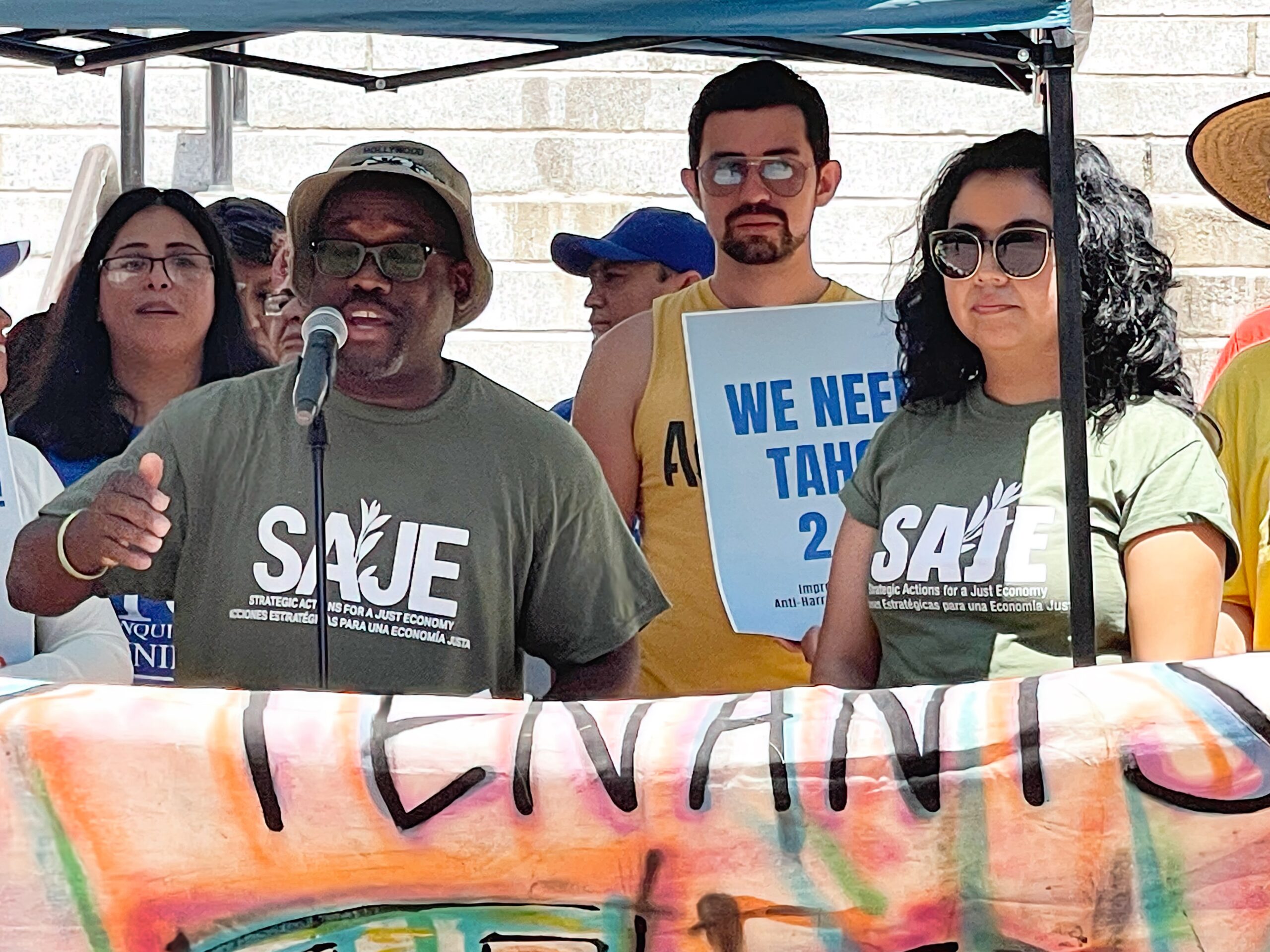


By Hannah Ouyachi, SAJE Intern
June 8, 2026
Since 2021, there have been over 24,000 tenant harassment complaints filed with the city, according to recent data from the Controller’s Office. Tenant harassment is an increasingly common feature of modern tenancy in Los Angeles, particularly for low-income tenants in rent-stabilized units. Landlords often use harassment to make conditions so unpleasant that a tenant chooses to leave, then allowing the landlord to raise the rent to market rate. Harassment can range from threats and assault to persistent negligence, utility shut-offs, and illegal evictions.
The city’s Tenant Anti-Harassment Ordinance (TAHO), passed in 2021, seeks to address this, prohibiting harassment and providing administrative and legal recourse for tenants. Tenants can file a complaint with the Los Angeles Housing Department, which then investigates and penalizes landlords, or tenants can sue their landlord directly in small claims court or through civil litigation. In 2024, the ordinance was amended to strengthen its enforcement capacity, increasing incentives for private attorneys to take on TAHO cases. However, enforcement remains limited and the process opaque.
For my master’s in urban planning program capstone project, I worked with SAJE to understand and assess the TAHO enforcement process, exploring its strengths and shortcomings and identifying opportunities for stronger enforcement.
Key Findings
TAHO Strengths
- TAHO introduced an expansive definition of harassment, meaningful protections and targeted recourse, and strong standing for tenants to sue their landlords, all of which did not exist before. TAHO also provides fodder for tenant organizing against harassment.
- The 2024 amendments to guarantee attorney fees for prevailing parties in court make TAHO cases substantially more viable for private attorneys, many of whom are increasingly integrating TAHO claims into their cases and are better able to support tenants facing harassment.
TAHO Limitations and Challenges
- Legal: Private attorneys and legal service providers lack sufficient capacity to take on all TAHO cases they receive. As TAHO is still relatively nascent, there remains uncertainty and perceived risk associated with taking on TAHO cases. More broadly, investing in legal remedies for a problem as pervasive as harassment is insufficient. Litigation is not a fit for all tenants or situations and typically takes years (whereas harassment is often acute and urgent), underscoring the importance of complementary effective, efficient administrative recourse.
- Administrative: LAHD’s complaint process is complex, lacks transparency, and generally does not result in resolution for tenants or consequences for landlords. Cases are not reaching the appropriate body to issue citations or prosecute landlords. This may be due to internal cultural or operational barriers within the housing department, including insufficient capacity, limited training, and potential bias.
- Structural: Both administrative and legal enforcement—which take months if not years—are misaligned with the urgency of harassment, and TAHO’s construction does not address the systemic drivers of harassment, connections among issues of harassment, eviction and habitability, or underlying barriers to enforcement.
Recommendations
- Build a more consistent, clear, and transparent LAHD process (e.g., develop specific guidelines for assessing and escalating complaints, hire dedicated TAHO staff and institute harassment-specific training)
- Improve externally-facing LAHD process for tenants (e.g., increase communication with tenants and offer channels for tenants to directly contact investigators, develop a TAHO-specific complaint portal)
- Implement systems of external governance for LAHD to increase accountability and transparency (e.g., monthly external reviews of TAHO complaints, quarterly city council hearings with LAHD leadership, tenant feedback mechanisms)
- Address legal challenges to enforcement (e.g., expedite contract with legal service providers, educate private attorneys and judges)
Beyond addressing TAHO’s process-driven shortcomings, structural interventions are needed to disincentivize harassment. This includes implementing more coordinated and systematic enforcement across harassment, eviction, and habitability issues, strengthening tenant power through organizing and education, and instituting statewide vacancy control.
You can read the full study, “Harassed in L.A.,” by clicking here.