

By Carlos Gonzales, Community Organizer
August 25, 2026
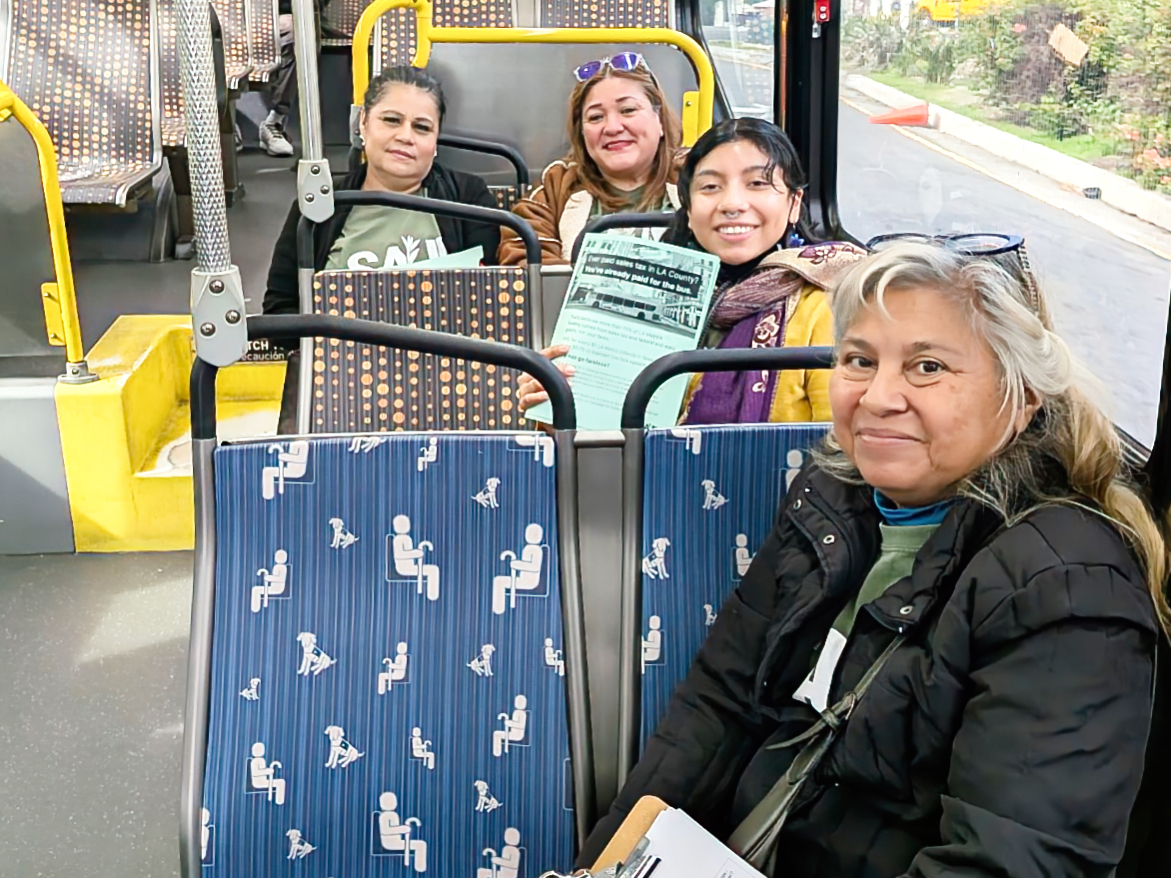
You can join the movement for fareless public transit by taking this survey and joining our Transit Justice Committee by emailing cgonzalez@saje.net Together we can organize and take action to build a public transit system that treats every rider with dignity and respect.
What if you weren’t allowed to use a public library because you couldn’t afford a library card? This would be considered a failure of an important public good. We don’t tell people they cannot use the library because they don’t have enough money; instead, library cards are free, and everyone is able to access the free resources libraries provide, like checking out books, using computers to apply for jobs, gathering with the community, or even just relaxing and escaping the heat.
Public transit should be a public good, too. Public transit supports quality of life by ensuring all Angelenos have mobility and access to opportunities, resources, and spaces. It should be available to all Los Angeles residents, regardless of income. No one should be left stranded or forced to miss work, school, a doctor’s appointment, or a job opportunity because they cannot afford bus fare.
Treating public transit like a public good matters because LA Metro is a lifeline for hundreds of thousands of working-class Angelenos, many of whom are already making difficult choices about how to stretch their limited incomes. Metro’s own 2022 Customer Experience Survey makes clear just how many riders are struggling with affordability: 89% of bus riders and 72% of rail riders earn less than $50,000 a year, while 43% of bus riders and 32% of rail riders earn less than $15,000 annually.
Metro’s Low Income Fare is Easy (LIFE) program was created to address fare affordability for these households. LIFE automatically gives qualifying riders 20 free rides at the start of every month. Let’s say you are a person who depends on the bus and rides it four times per day. With LIFE, your first five days of commuting would be free. But then what? In the remaining days, your fares will max out either at the $5.00 daily cap or the $18.00 weekly cap. In a month with 31 days, that adds up to $79 dollars. Over the course of a year, that adds up to more than $900 dollars, just for you—and most households have more than one person who relies on public transit.
Metro believes fare capping is the solution to affordability, but 43% of bus riders use cash as their main form of payment and are left out of the TAP system that runs fare capping. The majority of these riders are unbanked, with no access to electronic payment methods. A CASH to TAP Study Metro did in 2023 found that 66% of cash-dominant riders said they have to go out of their way to access TAP vending machines—in other words, they have to pay a fare to participate in fare capping. And for 62% of cash-dominant riders, loading more than a couple days’ fares at a time is a financial burden, meaning lots of extra trips to the TAP machine. In fact, Metro found 45% of cash-dominant riders only load one day’s worth of trips at a time because they would rather have money on hand to use for food or other essentials.
In June 2025, Metro introduced a motion to explore how LIFE could be improved, including identifying obstacles preventing riders from accessing the program. According to their findings, 57% of LIFE participants said that 20 free rides per month do not make transit affordable enough, 66% of riders said they “don’t understand LIFE / its complicated,” and 62% reported losing their LIFE TAP card after qualifying. When I’ve spoken with riders about why they don’t replace a lost LIFE TAP card, they often tell us they do not know how to get a replacement, enrollment and service locations are too far from where they live, or the process is confusing. Some riders have tried to get help, only to be redirected to Metro’s customer service department, ultimately giving up and returning to paying their fares with cash. These barriers demonstrate affordability is not just about offering the discounted fare—it is about making sure riders can actually access and maintain the benefit.
Fares are not just an affordability issue, they are a policing issue. Many equate fare enforcement with public safety, a logic that says “good” people pay and “bad” people don’t pay. The fact is, a lot of Metro riders don’t pay because they can’t afford to. These riders aren’t a threat to public safety; they’re people with not a lot of money who have no other option for getting around. As Metro’s own statistics show, the majority of riders are rent burdened, impacted by inflation, living paycheck to paycheck, and struggling to access reliable employment and economic opportunities. Fare enforcement criminalizes poverty by punishing people already struggling to afford the basic necessities for not having enough bus money.
Fare enforcement is also a tremendous waste of public dollars: For every $1.00 fare revenue LA Metro collects, $0.75 is invested in the fare enforcement system to fund policing, maintaining, powering, restocking, and collecting cash from the TAP vending machines, and software licenses, security administration—not in the riders they serve. Are we funding a transit system that is safe, accessible, and reliable, or funding more ways to police and exclude low-income riders?
The burden of fares falls heaviest on the very riders who depend on Metro the most. Metro should prioritize policies that make transit truly accessible to all—including moving toward a fare-free system that ensures no one has to choose between meeting their basic needs or being fined or arrested. Making public transportation accessible to all is a matter of both economic and racial justice: Roughly three-quarters of Metro riders are people of color, with 58% of riders identifying as Latino and 14% as Black/African American.
SAJE has been a longtime advocate for fare-free public transportation and has worked alongside riders and community members to strengthen and improve LIFE and highlight barriers to LIFE enrollment and sustainability. Los Angeles Mayor Karen Bass has said she supports a fareless transit system, and as chair of LA Metro’s Board of Directors she has the power to take steps toward creating one by expanding the LIFE fare-capping program into a fully fareless program.
You can join the movement for fareless public transit by taking this survey and joining our Transit Justice Committee by emailing cgonzalez@saje.net Together we can organize and take action to build a public transportation system that treats every rider with dignity and respect.